Software Testing Strategies: A Practical Guide for Teams That Ship Real Software
Published: 4 Aug 2026
A software testing strategy is a written plan that defines what gets tested, how deeply, in what order, and by whom, based on actual risk rather than gut feeling. It sits above individual test plans: where a test plan covers one release, a strategy covers an entire product or organization and gets revisited every quarter.
Direct Answer: A software testing strategy determines which risks get tested, how much effort each area deserves, and what gets cut when deadlines compress. Teams that document it explicitly ship faster and fix fewer production bugs because testing decisions are made once, calmly, not argued about in every sprint.
Why Most Test Strategies Fail Before Anyone Uses Them
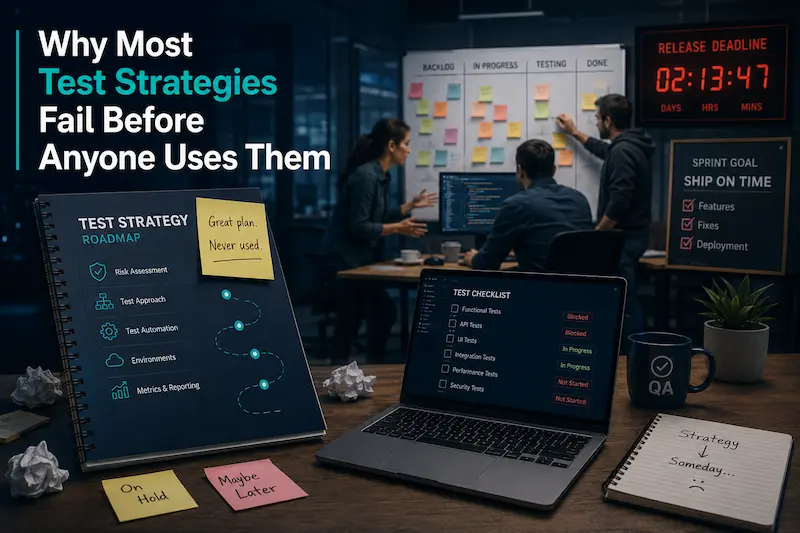
Most test strategies fail not because the plan is wrong, but because nobody answered one critical question before writing it: what happens when this strategy conflicts with a release deadline?
Teams spend days drafting entry and exit criteria, risk matrices, and tool lists, and then the whole document collects dust the moment a sprint gets tight.
The fix is building a “degradation plan” directly into the strategy, written before any crunch hits. Decide in advance which test types get deprioritized first under schedule pressure (usually exploratory testing and low-risk regression), and which never get cut (security scans on payment flows, for example). Putting that decision in writing removes the argument from the moment when nobody has time to argue it.
The Real Cost of Skipping a Structured Approach
IBM System Sciences Institute research, which still holds up in modern CI/CD environments, shows that a bug caught during requirements review costs roughly 6 times less to fix than one found during system testing, and around 15 times less than one found in production.
That gap does not shrink with daily deployments. In many cases it widens, because production incidents in a CI/CD pipeline touch more services and trigger more rollback complexity than a decade ago.
Here is what this looks like in practice. A team I worked with skipped a risk-based pass on a permissions change because it was “just a config update.” Three weeks later, a support ticket flood revealed that the change had silently broken data visibility for a subset of enterprise customers. The afternoon fix took six engineers a month to communicate and recover from in terms of customer trust. That is the real cost: not the bug, but everything downstream from finding it late.
Strategy vs. Approach vs. Technique: Why the Distinction Matters
This confusion is where delegation breaks down in real teams.
- Strategy is the top-level decision: what quality means for this product, and how much effort goes where. Set once per project or organization, reviewed quarterly.
- Approach is the direction taken within that strategy for a specific area, like choosing risk-based prioritization over exhaustive coverage, or bottom-up integration over big-bang.
- Technique is the mechanic used to build an individual test case, like boundary value analysis or a decision table.
Think of it as a funnel. Strategy decides “we’re prioritizing payment flows and cutting exploratory testing on the marketing site.” Approach decides “we’ll integrate payment services bottom-up with contract testing at each boundary.” Technique decides “we’ll test the discount calculator with a decision table covering every combination of coupon type and order size.”
When teams skip this distinction, junior testers end up debating boundary analysis versus equivalence partitioning when the real problem is that nobody set the strategy, so nobody actually knows whether this feature deserves deep testing at all.
Matching Your Strategy to Where Your Team Actually Is
Most guides describe testing strategies as if every company has the same resources. They do not. What works for a 20-person QA organization will bury a five-person startup in wasted time alone.
| Team Stage | What to Prioritize | What to Deliberately Skip |
| Pre-product-market fit | Core user journeys only, manual exploratory testing, no formal docs | Full regression suites, performance benchmarking, cross-browser matrices |
| Scaling (10-50 engineers) | API-level automation, CI-gated regression, defined entry/exit criteria | Exhaustive UI automation, formal strategy docs per feature |
| Enterprise / regulated | Compliance traceability, multi-environment validation, DAST/SAST in pipeline | Nothing gets skipped, but everything gets prioritized by regulatory exposure |
The mistake I see constantly: early-stage startups importing enterprise-grade test processes because a senior hire did it that way at their last company. It kills velocity for zero quality benefit, because the risk profiles are completely different. A startup’s biggest risk is building the wrong thing quickly. An enterprise’s biggest risk is breaking something a regulator or auditor will notice.
Where AI Actually Helps in Your Testing Strategy (And Where It Does Not)
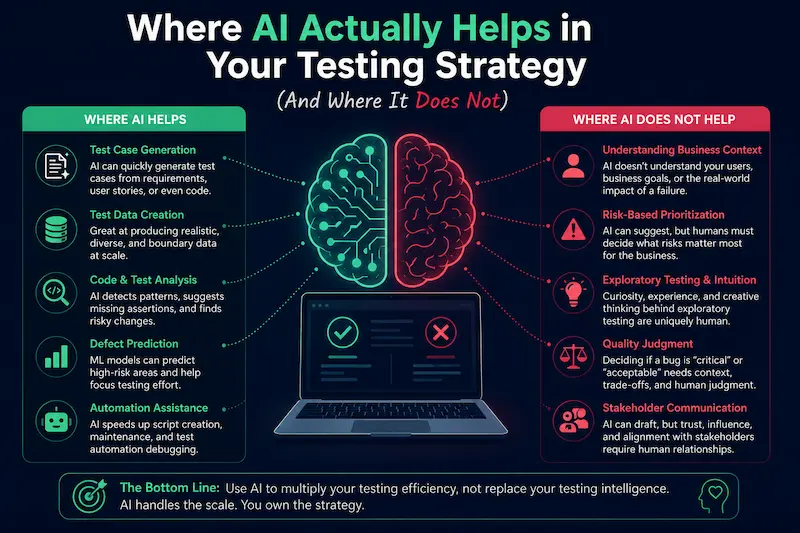
AI-assisted testing gets talked about as a single “add AI to your pipeline” decision. It is not. It changes something different at every stage, and conflating them is how teams end up with AI-generated tests nobody trusts.
Here is how it breaks down by pipeline stage:
- Requirements review: AI flags ambiguous acceptance criteria and missing edge cases in a spec before a single test gets written. Genuinely useful and underused.
- Test design: Fast first-draft generator for boundary conditions and negative scenarios. It is poor at knowing which scenarios actually matter to your business logic, so human review is essential.
- Execution: Self-healing locators and flaky-test detection save real engineering hours. This is the highest-ROI application in most pipelines.
- Triage: Clustering failed runs by likely root cause cuts investigation time significantly, especially in large regression suites where one underlying bug can fail thirty tests.
- Production monitoring: AI-assisted anomaly detection on logs and traces catches behavioral drift that scripted tests were never designed to catch.
The mistake to avoid: letting an AI-generated test pass code review just because it is green. A passing test with a weak assertion is worse than no test at all, because it creates false confidence. Every AI-drafted test needs a human to verify that the assertion maps to a real requirement, not just “the response returned something.”
The Test Environment Problem
Competitors rarely cover this, but environment gaps cause more wasted testing hours than any strategy flaw.
A strategy that does not address environment parity is incomplete. If your staging environment runs a different database version, uses stubs instead of real third-party services, or gets shared between multiple teams without isolation, your test results do not reliably predict production behavior.
Practical rules worth building into your strategy:
- Define which environments exist, what each one mirrors, and which test types run against each.
- Treat environment setup as a test dependency, not an IT task to handle later.
- For teams running parallel feature branches, container-based ephemeral environments (spun up per pull request) prevent the “who broke staging?” argument entirely.
- Any test that requires production-like data volume should explicitly document where that data comes from and how it is anonymized.
Skipping this section in your strategy document guarantees you will have the environment argument at the worst possible time: during a release window.
Shift-Left Is a Strategy Decision, Not a Buzzword
Shift-left testing means moving quality checks earlier in the development cycle. It is worth naming explicitly in your strategy because it changes who does what work.
Done correctly, shift-left means developers own unit and integration test coverage, QA joins sprint planning to review requirements before a line of code is written, and security scans run on every pull request instead of at release time.
Done poorly, it means giving developers a list of test cases to write at the last minute, which is just shift-left in name only. The real requirement is that testing involvement starts when requirements are drafted, not when code is ready.
If your strategy does not say when QA gets involved in the development cycle, the default answer becomes “whenever they have bandwidth,” which means late.
Four Real Examples Where the Strategy Drives the Outcome
E-commerce flash-sale platform. The dominant risk is not bugs; it is load. The strategy centers on performance and spike testing weeks before major sale events. Functional regression is automated but kept lightweight so it does not slow deploys. Checkout and inventory-lock logic gets the deepest manual exploratory pass, because race conditions under concurrent purchases rarely show up in scripted tests.
Healthcare patient-records system. Compliance drives everything. Every release requires documented traceability from requirement to test case to result, because auditors will ask for it. Security testing is not a milestone activity; it is continuous. SAST runs on every pull request, DAST runs against staging weekly, and a manual penetration test happens before every major version release.
Mobile-first consumer app with offline mode. The strategy accounts for device fragmentation and network state, not just logic correctness. Test matrices prioritize real device coverage over emulators for the offline sync path, because sync-conflict bugs almost never reproduce the same way on a simulator.
Internal B2B tool with a small, known user base. The honest answer here is: less testing, not more. With 200 known users and a support team that can catch issues quickly, heavy automation investment does not pay back. The strategy leans on smoke tests for critical paths and fast manual verification after each deploy, freeing engineering time for the product areas that actually need depth.
The pattern across all four: the strategy follows the risk, not a template. Copying the healthcare team’s compliance rigor into the internal tool would waste months for no benefit. Copying the internal tool’s light-touch approach into healthcare would fail an audit.
Build Your Test Strategy in Six Repeatable Steps
This sequence works whether you are writing a strategy for the first time or repairing one that has quietly stopped working.
- Name your top three risks in plain language. Not “poor test coverage,” but specific failure modes: “payment retries could double-charge a customer,” “the search index could silently return stale results.” Specific risks produce specific tests. Vague risks produce vague plans nobody follows.
- Write down what you will NOT test, and why. Every strategy defines scope, but almost none explicitly document what is excluded. This single step prevents the most common sprint planning argument: “wait, why is this untested?”
- Map test types to your actual release cadence, not an idealized one. If you deploy twelve times a day, a two-hour manual regression pass is dead on arrival. Build around what your pipeline can realistically support.
- Assign ownership by test type, not by person name. Who owns unit test coverage. Who owns regression suite health. Who owns flaky test triage. Individual names change; roles should not.
- Write the degradation plan before you need it. Which test types get cut first under deadline pressure, and which never get cut. Decide this calmly, in advance.
- Review the strategy against actual production incidents every quarter. If a bug slipped through, ask honestly: did the strategy miss this category of risk, or did someone skip a step the strategy already covered? Those are two very different fixes.
A Test Strategy Template You Can Use Today
Copy this into a document and fill it in. It is deliberately shorter than most templates, because a strategy document nobody reads is worse than no document at all.
- Top 3 risks this release cycle: (specific failure modes, not generic coverage gaps)
- In scope / out of scope: (name what is excluded and why, not just what is included)
- Test types by risk tier: (high-risk features get X, medium get Y, low get Z)
- Automation vs. manual split: (and the rationale, not just the ratio)
- Entry criteria: (what must be true before testing begins)
- Exit criteria: (what must be true before release)
- Environment map: (which test types run against which environments, and what each mirrors)
- Shift-left touchpoints: (when QA joins requirements review, design, and sprint planning)
- Degradation plan: (what gets cut first under deadline pressure; what never gets cut)
- Owner per section: (role, not name)
- Next review date: (an actual calendar date, not “as needed”)
Signs Your Current Strategy Has Stopped Working
You do not need a formal audit to spot a strategy that has quietly broken down.
- Bugs keep surfacing in areas your test suite technically “covers.”
- The team argues about what to test in every sprint planning meeting, which means the strategy never answered that question.
- Regression suites take longer than anyone has patience for, so people start skipping them locally before pushing.
- Nobody can tell you the last time the strategy document was opened, let alone updated.
- A test environment issue caused a failed release and nobody had documented what that environment was supposed to mirror.
If two or more of these sound familiar, the fix usually is not more tests. It is returning to step one above and re-naming the actual risks, because the strategy is probably testing yesterday’s problems.
Frequently Asked Questions
What is the difference between a proactive and a reactive testing strategy?
A proactive strategy involves QA early in the development cycle, reviewing requirements and designing tests before code is written. A reactive strategy tests the finished product. Proactive approaches catch defects earlier and at lower cost, but require QA involvement in planning phases that many teams still treat as developer-only territory.
What should a testing strategy include for a CI/CD pipeline?
It should define which test types run automatically on every pull request (unit, integration, static analysis), which run against a staging environment on merge (smoke, regression), and which run on a schedule or before release (performance, security, exploratory). It should also specify what happens when an automated check fails and who is responsible for fixing it.
How do you write a test strategy for a product you do not fully understand yet?
Start with the user’s most critical action, the one failure that would immediately cause them to leave or complain, and protect that path first. As the product comes into focus, expand the strategy around newly identified risk areas. A strategy written on partial information is still better than none, as long as it is reviewed and updated as understanding grows.
How is risk-based testing different from test prioritization? R
Risk-based testing uses a formal risk assessment to decide which areas get tested and how deeply, based on the probability and impact of failure. Test prioritization determines which already-planned tests run first when time is short. Risk-based testing shapes the strategy; prioritization shapes the execution order within it.
What test types belong in a strategy for a third-party API integration?
Contract testing to verify that the integration behaves as documented, negative tests covering API downtime and malformed responses, and monitoring in production for silent behavior changes. Third-party APIs can change without warning; your strategy should include a defined process for detecting and responding to breaking changes.
How do you handle test strategy across multiple teams working on the same codebase?
Define a shared strategy at the organization or product level covering standards, environments, and coverage expectations. Each team then owns a scoped approach within that framework for their area. The most important piece is shared ownership of the integration and end-to-end test layer, because that is where cross-team dependencies create the highest risk.
When does a testing strategy need to be replaced rather than updated?
When the architecture changes significantly (moving from a monolith to microservices, for example), when the compliance requirements shift substantially, or when the team size crosses a threshold that makes current processes unworkable. Incremental updates work for adjusting scope and priorities; a full replacement is warranted when the underlying assumptions the strategy was built on no longer hold.





- Be Respectful
- Stay Relevant
- Stay Positive
- True Feedback
- Encourage Discussion
- Avoid Spamming
- No Fake News
- Don't Copy-Paste
- No Personal Attacks
- Be Respectful
- Stay Relevant
- Stay Positive
- True Feedback
- Encourage Discussion
- Avoid Spamming
- No Fake News
- Don't Copy-Paste
- No Personal Attacks
